
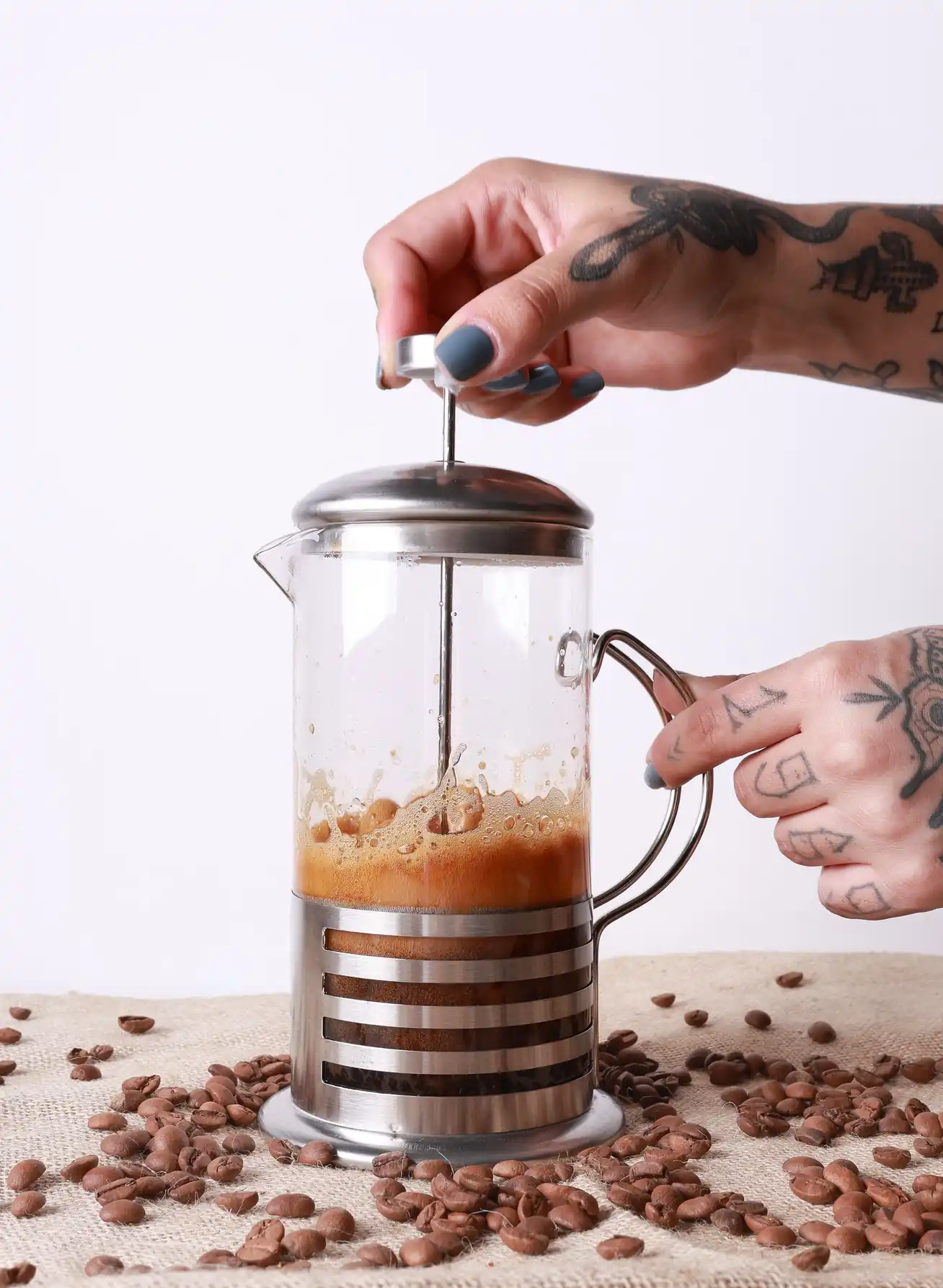
French Press vs Pour-Over: Which Brewing Method Is Right for You?
Both methods start with the same beans and roughly the same water. What changes everything is contact time, filtration, and how much control you have over the pour. Here's how they actually compare, method by method, not just in theory.
Side-by-side comparison
| French Press | Pour-Over | |
|---|---|---|
| Grind size | Coarse (like sea salt) | Medium-fine (like table salt) |
| Brew time | ~4 minutes steep | ~2:30–3:30 pour + drain, roughly 3–4 min total |
| Coffee-to-water ratio | Roughly 1:11 to 1:16 | Roughly 1:15 to 1:17 |
| Filtration | Metal mesh — oils and fine sediment pass through | Paper filter — oils and sediment stay behind |
| Body & mouthfeel | Bold, heavy, full-bodied, some sediment in the cup | Clean, light, tea-like clarity |
| Flavor clarity | Rounder, less distinct between origins | Brighter, shows off origin-specific notes |
| Equipment needed | French press + kettle | Dripper + paper filters + gooseneck kettle, ideally a scale and grinder |
| Upfront cost | Low — one piece of gear, no consumables | Higher — more gear, plus ongoing filter cost |
| Learning curve | Low — hard to mess up badly | Moderate to steep — pour technique affects the result directly |
| Best for | Mornings when you want no-fuss, strong coffee | When you want to taste what makes a specific bean or roast distinct |
Grind size: the first fork in the road
The two methods use opposite ends of the grind spectrum, and the reason is mechanical, not stylistic. French press is an immersion method — grounds sit fully submerged in water for several minutes, so a coarse grind is needed to slow extraction and keep the grounds from turning into sludge that clogs the plunger. Pour-over is a percolation method — water passes through the grounds once on its way to the cup, so a finer, medium-fine grind (similar to table salt) is needed to create enough resistance for proper extraction as the water flows through.
Use the wrong grind for the wrong method and the result shows immediately: coarse grounds in a pour-over drain too fast and taste weak and sour; fine grounds in a French press turn muddy and bitter, and the mesh filter won't hold them back properly.
Brew time and ratio
French press steeping generally runs about 4 minutes, full stop — it's a fixed, mostly hands-off window. Pour-over is closer to 2:30–3:30 of active pouring, plus drain-through time, landing around 3–4 minutes total, but it isn't hands-off: how fast and evenly you pour changes the final result.
Ratios also differ. French press typically runs a bit stronger, in the neighborhood of 1:11 to 1:16 (coffee to water by weight), while pour-over tends to run slightly more diluted, around 1:15 to 1:17. Neither range is a hard rule — both are starting points to adjust from based on taste.
Body and clarity: where the real difference lives
This is the part people notice first when they switch methods. French press uses a metal mesh filter, which lets fine coffee particles and natural oils pass straight into the cup. That's what gives French press coffee its characteristic heavy, full-bodied mouthfeel — and also its sediment at the bottom of the cup.
Pour-over uses a paper filter, which catches almost all of that sediment and most of the oils. What's left is a lighter-bodied, cleaner cup that tends to show more of the coffee's specific flavor notes — the fruitiness of an Ethiopian light roast, for instance, or the chocolate notes in a Central American medium roast — because there's less heavy body masking them.
Neither is more "correct." Full-bodied and sediment-forward is a feature if that's the coffee experience you want; clean and bright is a feature if that's what you want instead.

Equipment cost and learning curve
French press wins clearly on both simplicity and cost. It's one piece of equipment, no ongoing consumables, and close to foolproof — coarse grind, water, wait, press. It's genuinely hard to ruin a cup badly enough that it's undrinkable.
Pour-over asks more of you. A proper setup typically includes a dripper (like a V60 or Kalita Wave), paper filters as an ongoing cost, and ideally a gooseneck kettle for pour control and a scale for consistent ratios. The technique itself — pour rate, pour pattern, bloom timing — directly shapes the final cup, which is exactly why some people enjoy it: it's an active, almost meditative ritual with a visible feedback loop between what you do and what ends up in the mug. That same quality makes it a steeper learning curve for someone who just wants coffee fast on a weekday morning.
So which one should you actually get?
If your priority is speed, low cost, and a strong, no-fuss cup — start with a French press. If you're drawn to the process itself, want to taste the differences between beans and roasts more clearly, and don't mind a few minutes of hands-on technique each morning, pour-over is worth the extra gear and the learning curve. Plenty of coffee drinkers eventually own both and pick one or the other depending on the morning.
Methodology & disclosure
Grind size, brew time, ratio, and body/clarity comparisons in this article are cross-checked against brewing guidance from Fellow Products and multiple independent brewing guides, cited below. Where sources gave slightly different ratio ranges, the broader range is reported rather than a single cherry-picked number. No search-volume or keyword-demand figures are cited in this article because no verified data source was available for this topic.
This is independent editorial content. JoeScout may earn a commission on equipment links elsewhere on the site; brewing method recommendations here are not tied to any specific product.
Sources:
- Fellow Products, "French Press vs. Pour Over" — https://fellowproducts.com/blogs/learn/french-press-vs-pour-over
- Barista At Home, "Coffee Grind Size Guide" — https://myhomebarista.com/guides/coffee-grind-size-guide/
About the author
Jordan Silva — Small-kitchen equipment tester, 6 years. Tests and repairs coffee equipment daily as part of running a 12-seat café. Every guide is based on machines and methods actually owned and used.